
If you have ever wondered what it actually means when a company says it is “committed to sustainability” or “working toward net zero,” you are not alone. These phrases get thrown around constantly in annual reports, marketing campaigns, and press releases, but what do they actually look like in practice? How does a company go from vague environmental intentions to real, measurable accountability?
This guide is for anyone who wants to understand the systems, frameworks, and metrics that companies use to measure their environmental impact. Whether you are a business owner just starting your sustainability journey, a student studying corporate responsibility, an employee curious about your company’s environmental performance, or simply a conscious consumer who wants to know what is really going on behind the green labels, this post is written for you. Catch up on previous and more posts on environment and sustainability.
Table of Contents
Why Measuring Environmental Impact Matters
Before we get into the how, let us talk about the why.
When we talk about the environmental impact of a company, we are referring to the combined effects that its activities have on the natural environment. These can take many forms, such as air and water pollution, excessive consumption of natural resources, waste generation, and ecosystem degradation.
Here is the thing: you cannot manage what you cannot measure. A company that has no idea how much carbon it emits, how much water it consumes, or how much waste it sends to landfill has no starting point for improvement. Measurement is the foundation of everything, it is what separates genuine sustainability efforts from greenwashing.
Studying a company’s environmental impact makes it possible to identify and quantify these effects, facilitating decision-making to mitigate damage and promote more sustainable practices.
And the stakes are getting higher. According to recent research, 81% of institutional investors across Europe now integrate ESG factors into their investment decisions. Companies with strong ESG performance metrics demonstrate better risk management, attract more capital, and build lasting competitive advantages.
In short, environmental measurement is no longer just an ethical obligation, it is a business imperative.
What Exactly Is “Environmental Impact”?
When sustainability professionals talk about environmental impact, they are referring to a wide range of effects a company’s operations have on the planet. These typically fall into several categories.
Carbon and greenhouse gas emissions are the most talked-about, covering the gases a company releases into the atmosphere through its operations, energy use, and supply chain. Energy consumption tracks how much electricity, gas, and fuel a company uses and where those energy sources come from. Water usage covers how much water a business withdraws, consumes, and potentially pollutes through its activities. Waste generation includes everything from packaging and food waste to industrial byproducts and hazardous materials. Land use and biodiversity looks at how a company’s operations affect ecosystems, habitats, and species. Supply chain impacts extend the lens beyond a company’s own walls to look at the environmental footprint of suppliers and partners.
Think of these indicators as the vital signs of your organization’s environmental health. They transform abstract environmental concepts into concrete, measurable data points that can guide strategic decision-making.
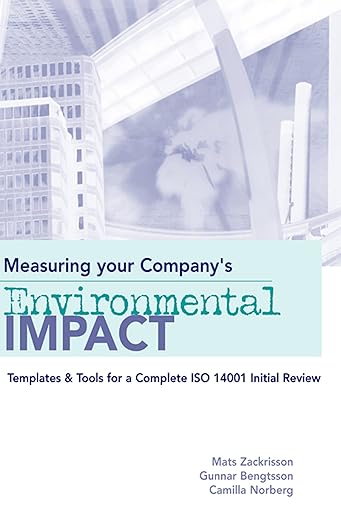
Measuring Your Company’s Environmental Impact: Templates and Tools for a Complete ISO 14001 Initial Review
How to Measure your Company’s Environmental Impact is the most cost-effective and easy-to-use environmental review solution for companies in all sectors of the economy. Designed and written by top environmental engineers, and used by top consultants and companies in Europe, this step-by-step manual contains extensive tools for managers to carry out a complete company-wide initial environmental review as a prerequisite for introducing an environmental management system in accordance with ISO 14001 or EMAS.
The Core Frameworks and Standards Companies Use
One of the most confusing things for beginners is the sheer number of acronyms and frameworks in this space. GHG Protocol, GRI, ISO 14001, ESG, CDP, SASB, it can feel overwhelming. Here is a plain-language breakdown of the most important ones.
The Greenhouse Gas Protocol (GHG Protocol)
This is the most widely used international accounting standard for greenhouse gas emissions, and it is the starting point for almost every company that measures its carbon footprint.
Current processes to measure a business’s environmental impact include sustainability standards and frameworks like the GHG Protocol Corporate Standard for assessing greenhouse gas emissions, CDP reporting for climate disclosures, and ISO 14001 for environmental management systems, alongside tools like life cycle assessments and ESG metrics aligned with GRI or SASB standards.
The GHG Protocol organizes a company’s emissions into three categories called “scopes.” Understanding these scopes is fundamental to understanding how carbon accounting works.
Scope 1 covers direct emissions. Scope 1 emissions are direct GHG emissions that occur from sources owned or controlled by the company, for example, emissions from combustion in owned or controlled boilers, furnaces, and vehicles, or emissions from chemical production in owned or controlled process equipment. Think of a factory burning natural gas, or a fleet of company-owned delivery trucks.
Scope 2 covers indirect energy emissions. Scope 2 accounts for GHG emissions from the generation of purchased electricity and heat consumed by the company. Purchased electricity is defined as electricity that is purchased or otherwise brought into the organizational boundary of the company, and Scope 2 emissions physically occur at the facility where the electricity is generated. So if your office runs on coal-powered grid electricity, those emissions belong in Scope 2.
Scope 3 is where things get genuinely complex and genuinely important. Scope 3 is a reporting category that covers all other indirect emissions. Scope 3 emissions are a consequence of the activities of the company but occur from sources not owned or controlled by the company. This includes everything from the emissions produced making the raw materials a company buys, to the carbon released when customers use or dispose of its products.
The Global Reporting Initiative (GRI)
The GRI Standard is used by 73% of the world’s 250 largest companies, across more than 100 countries. The GRI Standards are a modular system comprising three series of Standards: the GRI Universal Standards, the GRI Sector Standards, and the GRI Topic Standards.
GRI provides a comprehensive framework that goes beyond just carbon to cover a wide range of environmental and social topics. A company using GRI standards will report on everything from energy and water to biodiversity and supplier relationships. It is essentially a common language for sustainability disclosure, making it easier for investors, customers, and regulators to compare companies.
ISO 14001 — The Environmental Management System Standard
While GHG Protocol and GRI are about measuring and reporting, ISO 14001 is about how a company manages its environmental responsibilities as an ongoing system.
ISO 14001:2015 specifies the requirements for an environmental management system that an organization can use to enhance its environmental performance. It is intended for use by an organization seeking to manage its environmental responsibilities in a systematic manner that contributes to the environmental pillar of sustainability.
Think of ISO 14001 as the operational framework, the procedures, processes, and governance structures that make sure environmental performance is being tracked, improved, and embedded into day-to-day business decisions. Getting ISO 14001 certified signals to the market that your environmental management is systematic and independently verified.
If you want to go deeper on this, the book “Sustainable Business Practices: Integrating ISO 14001 for Long-Term Environmental Success” by Dr. Mohamed-Ali Ibrahim is one of the most practical resources available. It covers real-world applications and case studies for businesses of all sizes, and it walks through step-by-step implementation strategies in a way that makes the standard genuinely approachable.
For those who want the actual standard itself, the official ISO 14001:2015 documentation is available on Amazon and is an essential reference for any sustainability professional.
And if you are brand new to all of this, “ISO 14001:2015 — Environmental Management System (EMS) Beginner’s Guide” by Mohamed Nazeer Ali breaks down every clause in simple, accessible language, including what environmental aspects and impacts actually mean in practice.
CDP (Carbon Disclosure Project)
CDP is a not-for-profit that runs a global disclosure system for companies, cities, and governments to report their environmental data. The UK-based Carbon Disclosure Project offers help and supports disclosing the environmental impact of major corporations, with its focus on using carbon accounting principles to measure GHG emissions. Thousands of companies respond to CDP questionnaires each year, and their scores are publicly available, making CDP one of the most important transparency mechanisms in corporate sustainability.
The Key Environmental Metrics Companies Actually Track
Frameworks tell you how to measure. Metrics are what you actually measure. Here are the most important environmental metrics you will encounter.
Carbon Footprint
Carbon footprint is one of the most important metrics. It is an indicator of the total amount of greenhouse gases that a company generates either directly or indirectly. Carbon footprint is calculated by analyzing the consumption of fossil fuels and the energy used in production and transportation, among other factors.
The standard unit is tonnes of CO2 equivalent (tCO2e), which converts different greenhouse gases ,methane, nitrous oxide, hydrofluorocarbons into a common unit based on their global warming potential. This allows a company to add up all its different emissions sources into one comparable figure.
Total Carbon Footprint in tonnes CO2e provides a comprehensive picture of a company’s total climate impact, encompassing emissions generated throughout its supply chain.
Energy Consumption and Renewable Energy Use
Companies track both the total energy they consume and the proportion coming from renewable sources. Moving from fossil-fuel energy to renewable electricity is one of the most direct ways companies reduce their Scope 2 emissions, which is why renewable energy percentage is such a widely reported metric.
Water Consumption and Water Stress
Water is a key sustainability metric for most organizations, especially in manufacturing and the FMCG sector. Organizations can track their water usage, quality, the cost of water pollution on the environment, as well as loss of water through leaks and evaporation.
Companies in water-intensive industries like food and beverage, textiles, semiconductors are also increasingly expected to assess whether their facilities are located in areas of water stress, meaning regions where clean water is already scarce.
Waste Generation and Diversion Rate
Companies are beginning to focus on their contribution to the circular economy through waste management. Waste includes food and packaging waste, hazardous materials, debris and industrial waste, and final disposals. Plastic packaging and single-use materials can be replaced with recycled, recyclable, or circular materials.
The “waste diversion rate” is a common metric that tracks the percentage of waste kept out of landfills through recycling, composting, or reuse. A high diversion rate indicates a company is moving away from a linear “take-make-dispose” model toward something more circular.
Recycled Content and Circular Economy Metrics
Circular economy metrics measure the extent to which a company is adopting circular economy principles, including recycling, reuse, and remanufacturing. The percentage of recycled content in products showcases a company’s commitment to using recycled materials and minimizes reliance on virgin materials.
Biodiversity Impact
This is an emerging but growing area. Biodiversity conservation metrics assess the company’s impact on biodiversity, such as habitat loss and species extinction. Companies operating in industries like agriculture, mining, forestry, and construction are under increasing pressure to measure and disclose how their land use affects natural ecosystems.
Life Cycle Assessment: Thinking from Cradle to Grave
One of the most powerful and most underestimated tools in environmental measurement is the Life Cycle Assessment, or LCA.
LCA is a method for evaluating the environmental impact of products and services throughout their lifecycle from resource extraction through raw material production, product manufacturing, distribution and consumption, all the way to disposal and recycling.
The reason LCA is so valuable is that it stops you from solving one problem by creating another somewhere else. For example, a company might switch from plastic to paper packaging thinking it is more environmentally friendly but an LCA might reveal that the paper packaging requires significantly more water and energy to produce and actually has a higher overall impact. Without the full picture, well-intentioned decisions can backfire.
Cradle-to-grave is the full life cycle assessment from resource extraction through manufacturing, usage, and maintenance, all the way through to its disposal phase. Some companies conduct cradle-to-gate assessments, which stop at the factory gate and do not include the use and disposal phases. Others do cradle-to-cradle assessments, which assume materials will be recovered and reused at end of life rather than discarded.
LCAs often provide environmental impacts beyond just GHG emissions that provide insights into the holistic environmental impacts of a product or service. There are several reasons why an organization might conduct an LCA, to drive internal innovation toward environmental impact reduction, to satisfy an external policy requirement or client request, or to substantiate external marketing claims about the comparative sustainability of a product or service.
ESG Reporting: The Bigger Picture
You will hear the term “ESG” used constantly in the context of environmental measurement, and it is worth understanding exactly what it covers.
ESG stands for Environmental, Social, and Governance. Environmental covers everything we have discussed so far, carbon, water, waste, energy, biodiversity. Social covers how a company treats its employees, communities, and supply chain workers. Governance covers how the company is led and controlled, board composition, executive pay, ethical standards, and transparency.
One of the best ways to measure a company’s sustainability performance is by using ESG metrics, which assess an organization’s performance in environmental, social, and governance areas. These performance indicators not only monitor an organization’s progress but also determine areas for overall improvement.
A good ESG report is not a marketing document, it is a structured, data-rich disclosure that allows external stakeholders to assess a company’s real-world impact. Rather than simply tracking “carbon emissions,” a robust KPI might target “a 20% reduction in Scope 1 and 2 emissions intensity by 2026 from a 2023 baseline.” Specificity is what separates meaningful reporting from vague commitments.
How Companies Actually Collect Environmental Data
Understanding what to measure is one thing. Actually collecting the data reliably is another challenge entirely. Companies can use software and sensors to track their greenhouse gas emissions, energy and water usage, and waste generation.
Technology plays a pivotal role in modern environmental data collection. Digital tools and software platforms can automate much of the data gathering process, reducing human error and providing real-time tracking capabilities. Consider investing in specialized environmental management software that can integrate data from multiple sources and generate comprehensive reports.
For many companies, especially smaller ones, data collection starts more simply with utility bills, waste disposal records, and transport logs. The crucial first step is establishing a baseline understanding of your company’s environmental footprint by taking an inventory of current practices, collaborating with different departments to analyze utility bills, waste disposal records, and transportation data.
During your assessment, document everything meticulously. Create detailed spreadsheets that track current consumption levels, waste volumes, energy use, and other relevant metrics. This baseline data will be crucial for future comparisons and tracking your sustainability improvements.
The Materiality Assessment: Figuring Out What Matters Most
Not every metric is relevant to every company. A software company has very different environmental risks than a mining company or a food manufacturer. This is where the materiality assessment comes in.
A materiality assessment identifies which environmental, social, and governance topics are most relevant to your business and stakeholders. This process ensures resources focus on tracking ESG metrics that provide the most value. The assessment should engage diverse stakeholders including investors, employees, customers, and community representatives to understand their priorities and concerns regarding your ESG performance.
Organizations should focus on tracking the most material ESG issues rather than attempting to measure everything, building capability gradually over time. This is practical wisdom for any company starting out: pick the metrics that actually matter to your operations, get good at tracking those, and expand from there.
Setting Environmental KPIs and Targets
Once a company has baseline data and understands what to measure, the next step is setting specific, measurable targets and key performance indicators (KPIs).
Establishing clear KPIs and metrics is essential for businesses aiming to measure the impact of their innovative practices. Companies can track progress and outcomes by defining specific, measurable, and relevant indicators.
Standing for “key performance indicator,” a KPI in sustainability refers to a measurable metric that organizations use as a benchmark to track and assess their overall environmental, social, and economic impact.
Good environmental KPIs are time-bound and tied to a baseline year. Rather than saying “we will reduce energy consumption,” a strong KPI says “we will reduce energy intensity per unit of production by 30% by 2030, compared to our 2022 baseline.” The difference between these two statements is the difference between accountability and aspiration.
Common Environmental Reporting Frameworks Side by Side
To make sense of the landscape, here is a plain-language comparison of the major frameworks:
The GHG Protocol tells companies how to measure and account for greenhouse gas emissions across Scopes 1, 2, and 3. It is the foundation of almost all corporate carbon accounting globally.
GRI Standards provide a comprehensive disclosure framework covering environmental, social, and governance topics. Companies use GRI to structure their full sustainability reports and communicate with multiple stakeholder groups.
ISO 14001 is a management system standard that helps organizations build the internal processes needed to continuously improve environmental performance. It is certifiable and independently audited.
CDP is a disclosure platform and scoring system that pushes companies to publicly report their environmental data on climate, water, and forests. Companies are scored A through F, and the scores are public.
SASB (Sustainability Accounting Standards Board) provides industry-specific standards, recognizing that the material environmental topics for a bank are very different from those for an oil company or a retailer.
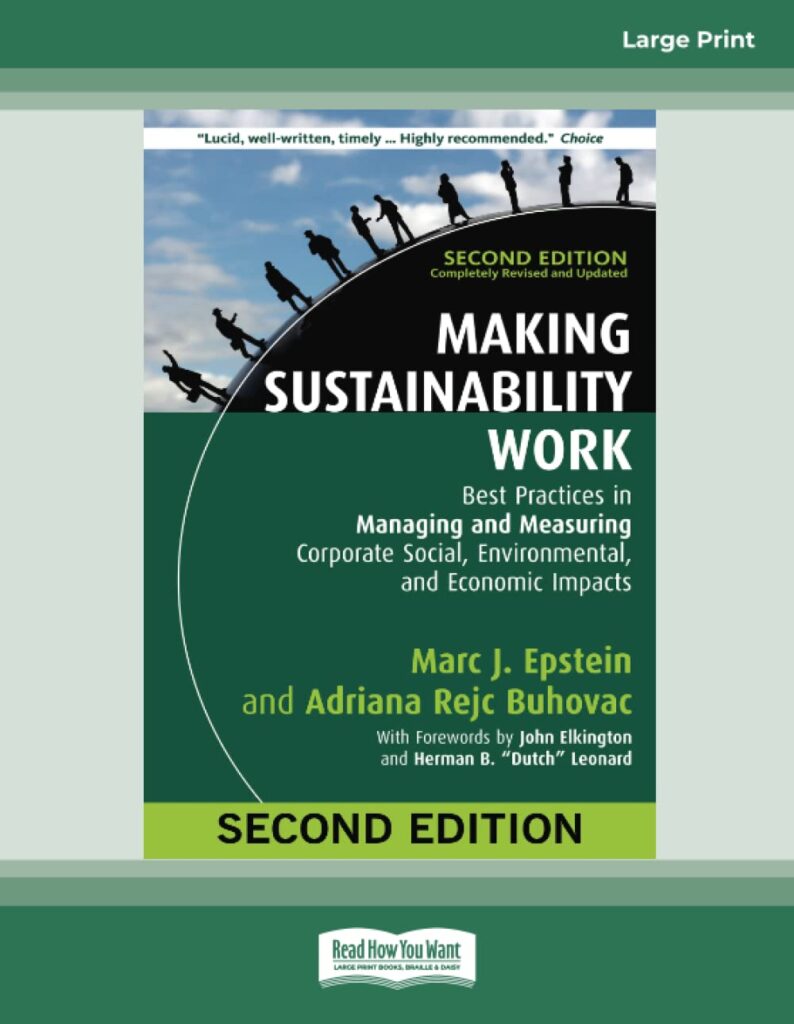
Making Sustainability Work: Best Practices in Managing and Measuring Corporate Social, Environmental, and Economic Impacts: Second Edition [large print edition]
Now completely updated, Making Sustainability Work is the bible for applying real metrics and best practices to the often – nebulous realm of business sustainability. Mark Epstein and Adriana Rejc Buhovac provide concrete tools for measuring and increasing social and environmental impacts in a manner that businesses can understand and put to real use.
What Greenwashing Looks Like And How to Spot It
Understanding how companies measure environmental impact also means understanding how companies can misrepresent it. Greenwashing is the practice of making environmental claims that are misleading, unverifiable, or outright false.
Some common warning signs include vague language like “eco-friendly” or “sustainable” with no specific data behind it, selective reporting that highlights one good metric while hiding worse ones, absolute reductions that are actually just efficiency gains while total output and total emissions grow, and carbon offset claims that substitute for, rather than supplement, actual emissions reductions.
The antidote to greenwashing is specificity. Trustworthy companies tell you exactly what they measured, how they measured it, what standard they used, what year they are comparing against, and whether the data has been independently verified. If those elements are missing, skepticism is warranted.
Where Small and Medium Businesses Fit In
A common misconception is that environmental measurement is only for large corporations. The reality is that businesses of every size are increasingly expected to measure and disclose their impact, not just because of regulation, but because their large corporate customers are starting to require it.
ISO 14001 is designed for all business sizes. Whether you run a startup, SME, or multinational corporation, scalable sustainability strategies exist for every stage of growth.
A practical tip for smaller businesses is to not try to track everything at once. Begin with a few key metrics and gradually expand your data collection as you gain experience. Educate everyone involved in operations on the importance of data collection and how their actions contribute to the larger goal.
Practical Steps for Any Company Starting Out
If you are reading this as someone responsible for starting your company’s environmental measurement journey, here is a realistic sequence to follow.
Start with an audit. Before you can measure progress, you need to know where you are. Gather utility bills, transport records, waste logs, and supplier information to build a picture of your current footprint. This does not have to be perfect on the first attempt, it just has to be honest.
Pick your framework. For most companies, starting with the GHG Protocol for emissions and GRI for broader reporting is the right move. ISO 14001 is the next step once you want to build formal management systems around your measurement.
Establish a baseline year. Choose a year with complete, reliable data to serve as your comparison point for all future progress measurement.
Set specific targets. Commit to measurable reductions within defined timeframes, tied to your baseline.
Engage your supply chain. For most companies, Scope 3 emissions dwarf Scopes 1 and 2 combined. That means your suppliers’ performance matters enormously to your own environmental footprint.
Report publicly and get verified. Third-party verification of your environmental data substantially increases credibility and forces internal discipline around data quality.
The Future of Environmental Measurement
Environmental measurement is evolving rapidly. Satellite data, AI-powered monitoring, real-time sensor networks, and blockchain-based supply chain tracking are all transforming what is possible. From sustainability software solutions like data management and resource optimization to analysis tools like carbon calculators and artificial intelligence, the possibilities are endless.
The direction of travel is clear. Companies that build robust environmental measurement systems today will be far better positioned to compete, attract capital, and retain trust in the years ahead. Those that ignore it will face growing regulatory, market, and reputational risk.
In Conclusion..
Measuring environmental impact is not glamorous work. It involves spreadsheets, data collection protocols, supplier engagement, third-party audits, and a lot of internal education. But it is the foundation of everything meaningful in corporate sustainability.
The companies doing this well are not just ticking compliance boxes, they are using environmental data to drive operational improvements, reduce costs, attract investors, and build genuine competitive advantage. And increasingly, they are being rewarded for it by markets that have finally started to price environmental risk properly.
Whether you are a CEO, a sustainability manager, a student, or someone who just wants to understand what is happening behind the corporate green rhetoric, the frameworks and tools in this guide give you the vocabulary and the context to engage meaningfully with one of the most important business conversations of our time.
Understanding how environmental impact is measured is the first step toward demanding and delivering something better.