
There is a particular kind of tired that anxiety produces. It is not the tired that sleep fixes. It is the tired that comes from carrying on a full-time conversation in your head that never, not once, gives you a moment of quiet. It is the tired of replaying conversations that happened three weeks ago. Of rehearsing conversations that have not happened yet and may never happen. Of running through every possible outcome of a situation before it has even had a chance to unfold. Of waking up at 2am with a chest that feels tight and a mind that is somehow already at full speed, cataloguing everything that could go wrong today, this week, this year, this life.
If that is familiar to you, you are not broken. You are not faithless. You are not failing at being a Christian. You are a woman whose nervous system has learned to treat uncertainty as a threat, and whose mind has taken on a job it was never designed to carry alone.
And there is a way through.
Not a way around. A way through. Because the healing that God does in anxious hearts is not the healing of avoidance. It is the healing of transformation. It is the slow, faithful, deeply personal work of learning to think differently, feel differently, and trust differently. It is the building of habits that create new grooves in your mind, new reflexes in your spirit, new defaults in your body.
This post is about those habits. The real ones. The ones that actually work, not just in theory but in the 2am moments, in the spiral moments, in the “I have prayed about this a hundred times and I am still scared” moments.
Let us go there together. Don’t miss any of previous posts, catch up on all of the Christian soft girl living posts.
Table of Contents
First, Let Us Talk About What Anxiety Actually Is
Because there is so much shame around anxiety in Christian spaces, and that shame makes it worse, not better.
Anxiety is not a sign that you do not trust God enough. Anxiety is not weakness. Anxiety is not the opposite of faith. Some of the most faith-filled people in scripture experienced profound fear and mental anguish. David wrote entire Psalms from inside what we would today recognize as an anxiety spiral. Elijah, after one of the greatest displays of prophetic power in the entire Old Testament, ran into the wilderness, sat under a tree, and asked God to let him die. He was depleted, terrified, and completely overwhelmed. And God did not rebuke him. God fed him, let him sleep, fed him again, and then spoke to him in a still small voice.
That is the God we are dealing with. Not a God who is frustrated by your anxiety. A God who meets you in it with food, with rest, with gentleness, and with His voice.
Anxiety, at its core, is what happens when your mind and body respond to perceived threat. It is a protective mechanism. The problem is not that you have it. The problem is when it becomes the dominant operating system of your inner life, when it is running in the background of every decision, every relationship, every quiet moment, consuming energy and peace and joy that were meant to be yours.
The habits in this post are designed to interrupt that operating system. Not violently. Not through willpower and performance. But through consistent, gentle, faith-rooted practice that trains your mind and body toward peace.
Christian Habits to Adopt to Calm an Anxious Mind and Life.
Habit One: Morning Scripture Before Morning Stimulation
The first thing you feed your mind in the morning sets the emotional tone for your entire day.
This is not a metaphor. It is neuroscience and it is theology agreeing with each other. When you wake up, your brain is in a highly receptive state. The content you consume in those first twenty to thirty minutes has a disproportionate influence on your mood, your thought patterns, and your stress levels throughout the rest of the day.
Most anxious women wake up and immediately reach for their phones. Within seconds they are absorbing other people’s highlight reels, news headlines, unread notifications, and the ambient anxiety of everyone they follow online. And then they wonder why they feel unsettled before they have even gotten out of bed.
The habit is simple but it requires real intentionality. Before you touch your phone, before you check anything, you give the first moments of your day to scripture.
Not a marathon Bible study. Not a performance. Even three to five verses, read slowly, read out loud if possible, spoken over yourself before the noise gets in.
A few passages that are particularly powerful for anxious minds include Philippians 4:6-7, which is the “do not be anxious about anything” passage, read not as a rebuke but as an invitation. Isaiah 41:10, “Fear not, for I am with you.” Psalm 46:10, “Be still and know that I am God.” Zephaniah 3:17, which describes God rejoicing over you, quieting you with His love. These are not just comforting words. They are declarations of reality that your anxious mind needs to hear before it starts writing its own story for the day.
The physical object matters more than people think. Having a Bible that you love, that you want to pick up, that feels like a gift rather than an obligation, actually affects your consistency with this habit. The CSB She Reads Truth Bible is designed specifically with women in mind, with devotional content, reading plans, and a layout that makes daily scripture engagement feel beautiful and accessible rather than heavy.
Habit Two: Prayer That Is Honest Instead of Polished
Here is something that keeps many anxious Christian women stuck in their anxiety even while they are praying about it.
They are performing their prayers.
They are presenting God with a spiritually appropriate version of how they feel rather than the actual truth of how they feel. They are asking for peace while not quite admitting how terrified they are. They are saying “I trust You, Lord” while internally screaming. And then they close the prayer and feel no different, and they wonder what is wrong with their faith.
The Psalms model a completely different kind of prayer. Psalm 13 opens with “How long, O Lord? Will you forget me forever? How long will you hide your face from me?” That is not a polished prayer. That is a desperate, honest, slightly accusatory cry from someone at the end of their rope. And it is in the Bible. God included it. God inspired it. That means God not only tolerates that kind of prayer, He welcomes it.
The habit of honest prayer is the habit of bringing the actual contents of your anxious mind to God rather than the edited version.
This might sound like: “God, I am terrified. I know I am not supposed to be and I know You are in control but right now all I can feel is fear and I do not know how to make it stop. I am giving this to You but I honestly do not even know how to let go. Please help me.”
That prayer is more powerful than any amount of polished religious language, because it is real. And God works with real. He works with what is actually true in you, not with the presentation you offer when you are trying to look like a good Christian.
The habit of honest prayer also means praying continuously in the way Paul describes in 1 Thessalonians 5:17, not as a formal exercise but as a running inner conversation with God throughout the day. When the spiral starts, instead of trying to stop it through willpower, you turn it into prayer. You narrate it to God. “I am starting to spiral about this situation. Here is what my mind is doing. I am giving You this thought. What do You say?”
You do not need to hear an audible answer. The act of turning toward God in the middle of the spiral is itself the interruption. It breaks the closed loop of anxious thinking by introducing a third presence into it.
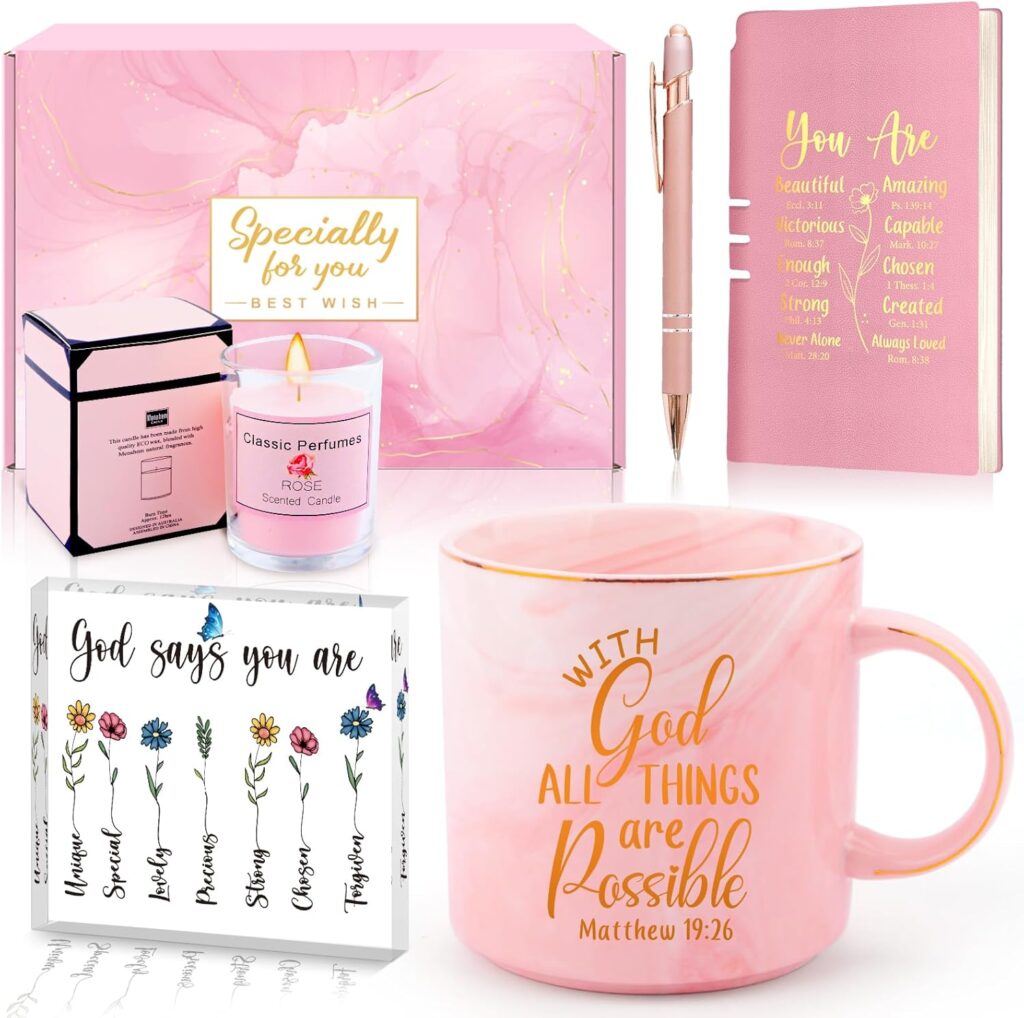
Christian Gifts for Women: This faith based gift set is ideal for Christian. Contains a 12oz “with god all things are possible” ceramics mug, a acrylic ” god says you are” desk sign, a rose scented candle, a notebook with pen. Elegant and fancy gift set ready for giving, no extra packing required. Design with the color of pink and gold, filled with a strong warm atmosphere, like a big hug to the recipient.
Habit Three: A Dedicated Worry Window
This is a habit borrowed from cognitive behavioral therapy and it is one of the most practically effective tools for overthinking, and it aligns beautifully with biblical principles about taking every thought captive.
Here is the problem with trying to simply stop anxious thoughts. Thought suppression does not work. The more you tell yourself not to think about something, the more you think about it. This is known as the rebound effect, and it is why “just stop worrying” is the least helpful advice anyone has ever given an anxious person.
The worry window works differently. Instead of suppressing anxious thoughts throughout the day, you contain them. You designate a specific fifteen to twenty minute window each day, usually not right before bed, as your designated worry time. When an anxious thought arises outside of that window, you write it down on a notepad and you tell yourself, “I will give this thought its full attention during my worry window. Right now is not the time.”
This does two things. It removes the urgency that anxiety attaches to its thoughts, the sense that you must figure this out right now. And it gives you a sense of agency over your own mental space. You are not ignoring the worry. You are scheduling it. Which means you are in charge of it rather than it being in charge of you.
During the actual worry window, you bring your list before God. You pray through each item. For each one, you ask three questions: Is this something I can take action on? If yes, what is one small step? If no, can I surrender this to God specifically and intentionally right now? And then you close the window. Deliberately. You say, out loud if it helps, “I have brought these to God. This time is over. I am choosing to move into the rest of my day.”
A beautiful, dedicated notebook for your worry window practice makes the habit feel more intentional and sacred. The Leuchtturm1917 Softcover Notebook is a favorite in this community for its quality and its gentle, unhurried feel.
Habit Four: Breath Prayer Throughout the Day
Your body is part of your anxiety, not just your mind. And your body is part of your healing, not just your spirit.
One of the most underestimated tools available to anxious women is intentional breathing. Not because breathing is a magic fix, but because your breath is the one physiological function that is both automatic and under your conscious control. It is a bridge between your conscious mind and your autonomic nervous system. When you slow your breath intentionally, you directly signal to your nervous system that you are safe. Your heart rate slows. Your muscles begin to release. Your prefrontal cortex, the part of your brain responsible for rational thought and emotional regulation, comes back online.
Breath prayer combines this physiological tool with direct communion with God, and the combination is genuinely powerful.
Here is the practice. Choose a short scripture phrase or a simple name for God. As you inhale slowly for four counts, you silently speak one phrase. As you exhale slowly for four to six counts, you speak the response or continuation. Some examples:
Inhale: “Be still.” Exhale: “And know that You are God.”
Inhale: “You are my shepherd.” Exhale: “I have everything I need.”
Inhale: “Perfect love.” Exhale: “Casts out fear.”
Inhale: “I am held.” Exhale: “I can let go.”
You do this for five to ten breaths. That is two to three minutes. You can do it at your desk. In your car before you walk into a hard conversation. In a bathroom stall during a stressful event. At 3am when your mind will not quiet. It is accessible anywhere, and it works.
The physiological sigh is also worth knowing for acute anxiety moments. It is a double inhale through the nose, a short sniff followed immediately by a longer one, followed by a long, slow exhale through the mouth. A single physiological sigh has been shown to reduce physiological stress more quickly than almost any other breathing technique. When you are in the middle of a spiral and need to interrupt it immediately, this is the tool.
Pairing your breath prayer practice with a gentle essential oil, something like lavender applied to your wrists or diffused nearby, can deepen the sensory grounding of the practice. The Healing Solutions Essential Oil Set includes both lavender and frankincense, which are the two most research-supported scents for calming the nervous system and have deep biblical and spiritual resonance.
Habit Five: Evening Gratitude as a Cognitive Reset
Anxiety is fundamentally a future-oriented experience. It lives in the not yet, the what if, the worst case scenario that has not happened but might. Gratitude is fundamentally a present and past-oriented experience. It lives in the what is, the what has been, the evidence of goodness that is already real.
This is why a consistent gratitude practice is not just a feel-good exercise. It is a cognitive intervention. It is a deliberate act of redirecting your attention from the imagined dangers of the future to the documented evidence of God’s faithfulness in your actual life.
The evening is the ideal time for this practice because the mind naturally begins to review the day as you move toward sleep. Anxious minds review the day for threats, for failures, for unresolved problems. A gratitude habit redirects that same reflective energy toward goodness.
The practice that goes deepest is not the standard list of three things you are grateful for, though that is a fine place to start. The practice that actually shifts the mind is specific, sensory, narrative gratitude. You describe the good thing in enough detail that your body re-experiences it. Not just “I am grateful for my friend.” But “I am grateful for the conversation I had with my friend this afternoon when she called just to check on me, and the way the sound of her voice reminded me that I am known and loved by someone who sees me.”
That level of specificity activates the same neural pathways as the original experience. Your brain does not fully distinguish between vividly remembered positive experience and current positive experience. You are literally giving your brain a dose of goodness before sleep.
You close this practice by thanking God specifically for each item. Not a list prayer, but a genuine acknowledgment of His hand in the details of your ordinary day. Over time, this practice builds what theologians call an Ebenezer, a stone of remembrance, an accumulating body of evidence in your own life that God is faithful, that He provides, that He shows up, that He cares about your details. And that body of evidence becomes the thing you reach for when anxiety tells you that you are not going to be okay. You have proof that you will be. You have been okay before. He has been faithful before. The record is there.
A dedicated evening journal that you use only for this practice keeps the habit clean and distinct. The Day One Journal, available in a beautiful linen-covered edition, is designed specifically for daily reflection and is a lovely companion for an evening gratitude and prayer practice.
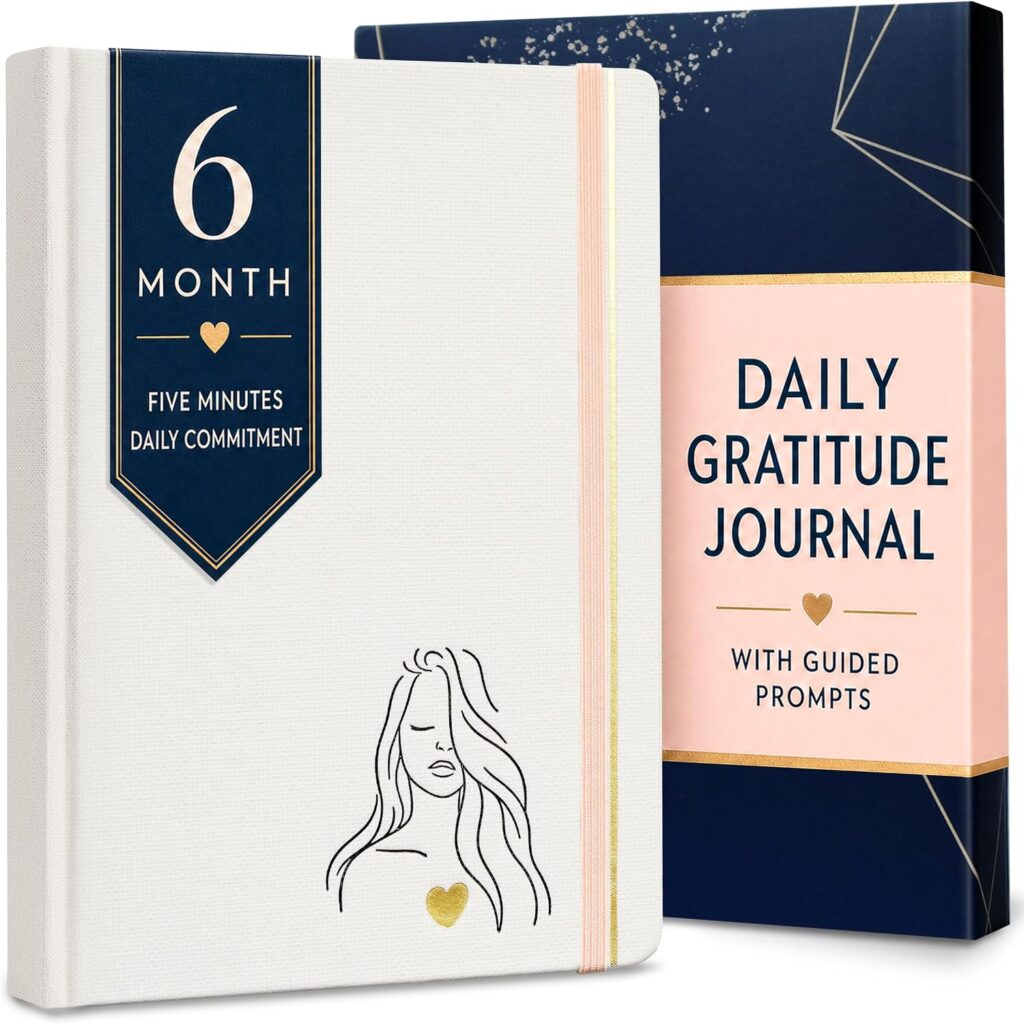
Premium Gratitude Journal for Women – 6 Month Guided Daily Prompts
5 Minutes Each Morning to Center Your Day: Each page guides you through a positive affirmation, gratitude prompt, and your top 3 priorities. Each evening, reflect on what made you happy and what you could improve. A simple structure that hundreds of women say helps them start mornings feeling focused, grounded, and ready to take on the day
Habit Six: Sabbath Rest as Anxiety Treatment
This one is going to challenge some of you, and it is meant to.
One of the most consistent patterns in anxious women is the refusal to rest. Not inability. Refusal. Because the anxiety makes rest feel dangerous. If you stop moving, stop managing, stop anticipating, something will go wrong. You will miss something. Something will fall apart. The anxiety has convinced you that your vigilance is what is keeping your life together, and that if you lower it, even briefly, everything will unravel.
This is a lie. And one of the most powerful ways to disprove it is to practice Sabbath.
Sabbath is not a suggestion. It is a commandment. And it is a commandment that God modeled personally, which is the most striking thing about it. God, who is omnipotent, who needs nothing, who cannot be depleted, rested on the seventh day. He did not rest because He was tired. He rested to demonstrate that cessation is built into the structure of a flourishing life. That there is something essential that only rest provides. That the world does not need your constant management to keep turning.
A weekly Sabbath practice does not have to look a particular way. It does not require you to follow a set of rules. It requires you to stop. To step back from work, from productivity, from the management of outcomes. To do things that restore rather than deplete. To be with God in a way that is spacious rather than squeezed into the margins.
For anxious women specifically, Sabbath is also a weekly act of faith. It is the practice of saying, with your schedule and your body and your choices, “I believe that You hold this. I believe that I do not have to be available to everything all the time for things to work out. I am choosing to trust You with the day I am not managing.”
Start small if a full day feels impossible. Begin with a half day. Begin with a Sunday afternoon that belongs to nothing and no one. Begin with saying no to one thing per week that you would normally say yes to out of anxiety about disappointing someone.
The peace that comes from this practice is unlike anything a supplement or a routine can produce. It is the peace of a soul that has actually, physically, chosen trust over control.
Habit Seven: Christian Community as Nervous System Regulation
You were not designed to manage your anxiety alone.
This is not a spiritual cliche. It is biological reality. Human beings are wired for co-regulation, the process by which the calm nervous system of another person helps to regulate an activated one. This is why you feel better after a genuine conversation with a grounded friend. This is why a hug from someone who loves you can interrupt a spiral in a way that two hours of self-talk cannot. This is why isolation and anxiety always make each other worse.
The church community, at its best, is exactly this. It is a gathering of people who carry one another’s burdens, who speak truth into each other’s fear, whose collective calm and collective faith create an environment where one person’s panic can be held by another person’s peace.
The habit is not just attending church. The habit is pursuing depth with a small number of women who know your real inner life. Women who know you are anxious and love you anyway. Women with whom you do not have to present a fine and together version of yourself. Women who will pray with you, not just for you. Women who will say, “I have been there too” rather than “you just need more faith.”
If that kind of community does not currently exist in your life, it is worth doing the uncomfortable work of building it. Join a small group. Be honest in a conversation with another woman rather than performing okayness. Start a simple two-person accountability check-in with a friend where you share one fear and one scripture each week. The intimacy builds in the doing of it.
Habit Eight: Limiting the Inputs That Feed the Spiral
Anxious minds do not need more information. They need better information and less of it.
One of the most honest self-assessments an anxious woman can do is to audit what she is consistently allowing into her mental space and ask whether those inputs are feeding peace or feeding anxiety.
This includes news consumption. It includes social media, particularly the comparison-heavy, hustle-culture, curated-perfection variety. It includes certain conversations that always leave you feeling more worried than before. It includes podcasts, books, and content that perpetually amplifies urgency and threat.
None of this means you disengage from the world. It means you become the gatekeeper of your own mind, which is exactly what “taking every thought captive” looks like in a media-saturated age. You choose what gets access to your inner space. You choose how much. You choose when.
Practical boundaries that many women in this community have found genuinely transformative include a no-phone-for-the-first-hour-of-the-morning rule. A social media curfew of one hour before bed. Unfollowing accounts that consistently produce comparison or anxiety rather than nourishment. Replacing a news habit with a single daily headline check rather than a continuous feed.
The space you create by limiting anxious inputs is not empty space. It is the space that gets filled with peace. With creativity. With the still small voice of God that you often cannot hear over the noise.
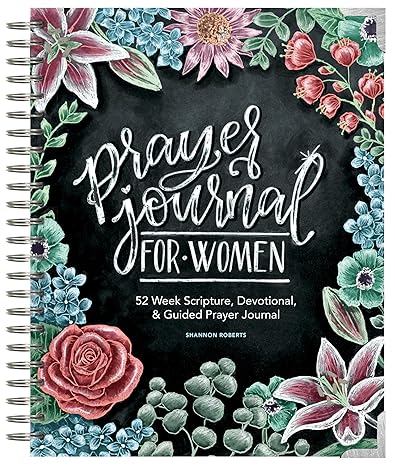
Prayer Journal for Women: 52 Week Scripture, Devotional, & Guided Prayer Journal
A Year of Faith and Growth
This devotional journal for women includes weekly Bible verses, reflections, and journaling prompts organized by theme: Love & Inner Beauty, Faithfulness, Strength, Grace, and more. Perfect for individual devotion or women’s Bible study.
When the Habits Are Not Enough
This needs to be said clearly and without apology.
Sometimes anxiety is not resolved by habits and spiritual practices alone. Sometimes it has physiological roots, thyroid disorders, hormonal imbalances, nutrient deficiencies, particularly magnesium and B vitamins, that require medical attention. Sometimes it has roots in trauma that require the specific kind of healing that happens in therapy with a trained professional. Sometimes it has reached a severity that warrants medication, and medication is not a failure of faith. It is stewardship of the body God gave you.
Pursuing counseling, particularly from a therapist who integrates faith, is one of the most courageous and loving things an anxious Christian woman can do for herself. The combination of spiritual practice and professional therapeutic support is not a contradiction. It is wisdom. It is using every tool God has placed in your hands.
If you suspect your anxiety has physiological roots, a magnesium supplement taken in the evening is one of the most widely recommended, well-tolerated, and evidence-supported starting points. Magnesium glycinate, specifically, supports nervous system function, promotes sleep quality, and helps regulate the stress response. The Pure Encapsulations Magnesium Glycinate is a high-quality, clean supplement that many women find genuinely helpful as part of a holistic approach to anxiety. Always consult your doctor before beginning any supplement.
You Are Not Fighting This Alone
There is a verse that does not get quoted in anxiety conversations as often as it should.
Romans 8:26 says: “In the same way, the Spirit helps us in our weakness. We do not know what we ought to pray for, but the Spirit himself intercedes for us through wordless groans.”
Read that again. The Spirit helps us in our weakness. Not when we have overcome our weakness. Not when we have enough faith to stop being anxious. In our weakness. Right now, in the middle of the spiral, in the middle of the 2am tightness in your chest, in the middle of the overthinking and the fear and the exhaustion of carrying it all.
The Spirit is interceding for you in the moments when you do not even have words for what you need. He is translating your wordless anxiety into prayer that reaches the Father.
You are not alone in this. You have never been alone in this.
The habits in this post are not a new performance to add to your already-long list of ways you are trying to be enough. They are an invitation. An invitation to create consistent points of return, throughout your day, throughout your week, in your morning and your evening and your quiet middle moments, where you practice turning toward the One who is already turned toward you.
That is all this is. Practice. Gentle, patient, imperfect practice.
And you are more than capable of it.