You know that feeling when your brain just will not stop? When you’re lying in bed at midnight and your thoughts are basically a browser with 47 tabs open, three of them are playing music, one is frozen, and you can’t find which one? Yeah. That feeling. We need to talk about it.
Mental clutter is one of the most exhausting things a human being can experience, and the wild part is that most people don’t even recognize it for what it is. You just feel foggy. Overwhelmed. Stuck. Irritable for no clear reason. Like you’re running on a full tank but somehow going nowhere.
Here’s what I want you to know: your mind is not broken. It’s just full. And just like a cluttered room, it needs a good clear-out every now and then.
That’s exactly what this post is for.
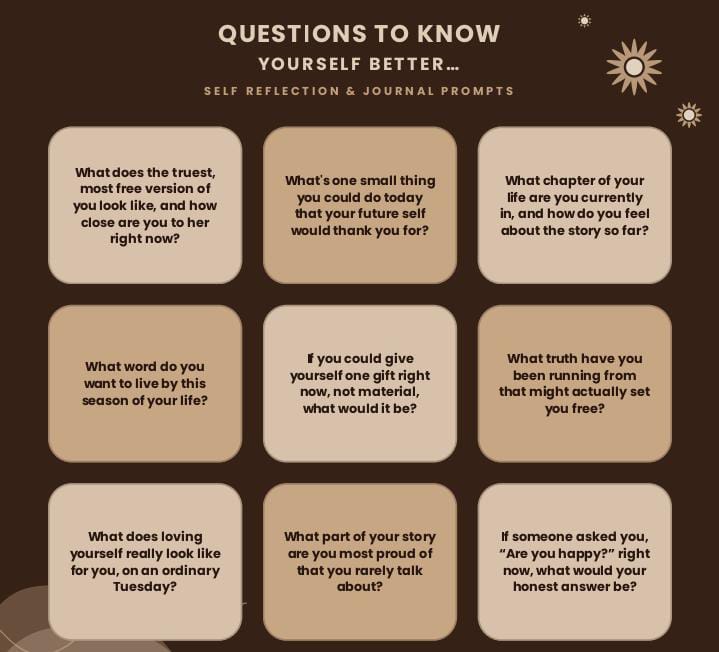
I’ve put together 200 journal prompts specifically designed to help you clear the mental noise, process what’s been sitting unexamined, untangle the thoughts you’ve been avoiding, and come back to yourself. These aren’t fluffy, vague prompts. These are the kind that make you go “oh”, the kind that get the stuck stuff moving.
But before we dive in, let’s talk about why this actually works, and how to do it properly so you get the most out of every single session. Catch up on more conversation starters and journal prompts you might have missed, we have lots of them for different life situations, parties and good times, it isn’t all gloom here.
Table of Contents
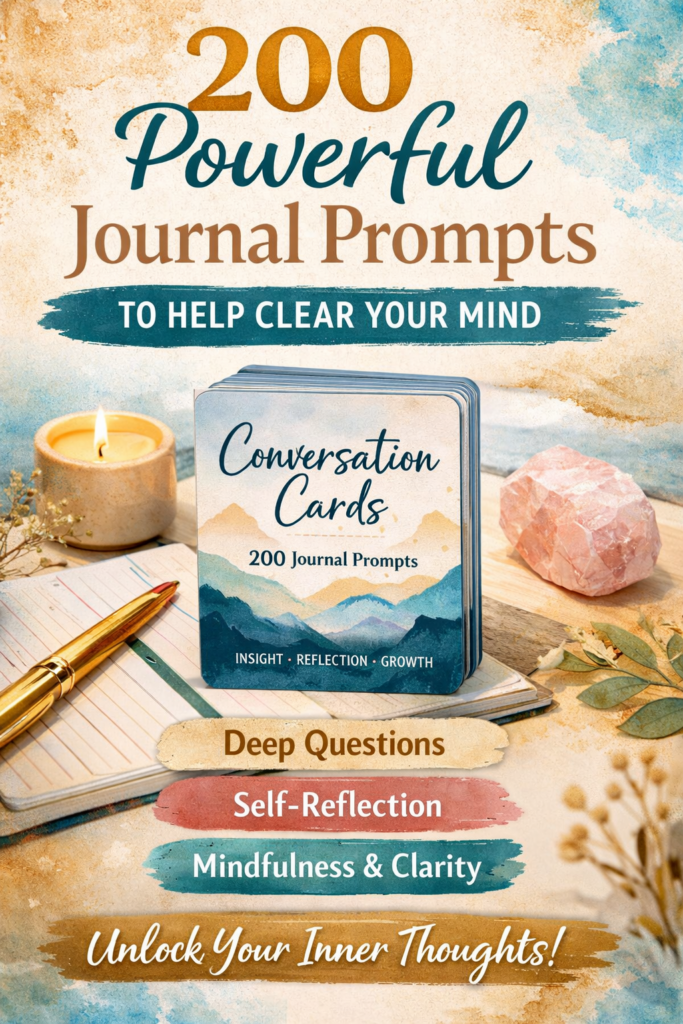
Good news alert, I’ve put together all the 200 journal prompts in this post and created cards for each section that you can download print and use whenever and wherever you feel like slowing down your thoughts. How cool is that? You don’t have to browse through the blog post.
Why Journaling Clears Your Mind
Journaling for mental clarity isn’t a new-age trend. It is genuinely, scientifically proven to work, and here’s why.
When thoughts stay inside your head, they circle. They loop. They get louder. Your brain has a limited amount of working memory, the mental space it uses to hold and process active thoughts. When that space is full of unresolved feelings, to-do lists, worries, old conversations, and unexpressed emotions, there’s simply no room to think clearly.
Writing those thoughts down externalizes them. It moves them from your overworked working memory onto a page, and your brain gets a signal that says: I don’t have to keep holding this. It’s been recorded. It’s safe to let go.
Dr. James Pennebaker, a pioneering psychologist at the University of Texas at Austin, has spent decades studying expressive writing. His research consistently shows that writing about your thoughts and feelings for as little as 15 to 20 minutes a day can reduce anxiety, improve mood, boost immune function, and help people make sense of confusing or painful experiences.
Additionally, journaling activates the prefrontal cortex; the rational, thinking part of your brain which actually calms down the amygdala, the part that triggers fear, stress, and emotional overwhelm. In other words, putting pen to paper literally changes what your brain is doing.
The result? You feel clearer, lighter, and more in control. Not because your problems disappeared, but because you finally gave them a place to land outside of your head.

Self-Mastery Journal for Men
All positive changes begin in the mind – and with the Realizations Self-Mastery Journal for Men & Women, you can live life to the fullest potential, Use this journals for men one page at a time.
How to Use These Prompts for Maximum Mental Clarity
Before you pick up your pen, here are the essential tips that will make the difference between journaling that actually clears your mind and journaling that feels like homework.
1. Write by Hand if You Can
There is real, documented science behind the pen-to-paper connection. Writing by hand engages different neural pathways than typing, and research shows it leads to deeper processing of thoughts and emotions. It slows you down in a good way. It forces you to be present with each word. If you only ever do one thing differently after reading this post, let it be this: put the laptop down and pick up a pen.
2. Set a Timer
Decision fatigue is real. If you sit down with no boundaries, your brain will spend half the time deciding when to stop. Set a timer for 10, 15, or 20 minutes and write until it goes off. This removes the friction and gives you permission to fully let go within that window. When the timer ends, stop. You can always go longer, but the timer removes the decision.
3. Write Without Editing
This is the single most important rule of clarity journaling. Do not go back and fix spelling. Do not re-read as you go. Do not cross things out. The inner editor is the enemy of mental clarity. Your journal is not a performance. It is a drain for whatever needs to get out. Messy, incomplete, contradictory all of it is welcome. Especially the messy stuff.
4. Pick One Prompt at a Time
Resist the urge to answer five prompts in one sitting, especially when you’re starting out. One good prompt, explored deeply, is worth ten surface-level answers. Sit with it. Follow the unexpected tangents. Sometimes the best journaling happens three paragraphs after you thought you ran out of things to say.
5. Don’t Judge What Comes Up
You might write something that surprises you. Something petty. Something sad. Something you didn’t know you were carrying. That’s not a problem. That’s exactly what’s supposed to happen. Clarity only comes when you let the unfiltered stuff out first. Judgment keeps the mental clutter locked in. Permission opens the drain.
6. Create a Simple Ritual Around It
Your brain loves context cues. If you journal in the same spot, with the same drink, at the same time of day, your brain will start to shift into openness and reflection faster each time you sit down. It doesn’t have to be elaborate. A candle, a cup of tea, your favorite chair, whatever signals to your nervous system: it’s safe to slow down here.
7. Keep Your Journal Private
This one matters more than people think. If there’s any chance someone might read it, you will self-censor without even realizing it. And self-censorship kills the whole purpose. The mental clutter you most need to clear is usually the stuff you’d be least comfortable sharing. Keep your journal somewhere private, or use a journal with a lock if that gives you more freedom to be fully honest.
8. Revisit Old Entries
Come back to what you’ve written after a week, a month, a season. You will be amazed at what has shifted, what has resolved, and what you can see with fresh eyes. Rereading old entries is one of the most powerful ways to observe your own mental patterns, track your growth, and realize how much of what once felt urgent no longer has a hold on you.
200 Journal Prompts to Clear Your Mind
These prompts are organized into eight categories so you can go straight to what your mind needs most on any given day.
SECTION 1: Brain Dump and Mental Declutter
For when you need to get everything out before you can think straight.
- Write down every single thing that is currently on your mind. All of it. Don’t stop until the page feels heavier than your head.
- What have you been meaning to deal with but keep putting off? List it all.
- What thought keeps coming back no matter how many times you push it away?
- What are you pretending not to be stressed about right now?
- What have you been trying to figure out lately that you haven’t been able to resolve?
- What feels unfinished in your life right now?
- What are you overthinking? Write the whole spiral out.
- What conversations are you replaying in your head? Write them out as they actually happened, not as you wish they had.
- What are you dreading in the near future? Say all of it.
- What do you need to say out loud that you haven’t said to anyone?
- What have you been carrying that isn’t even yours to carry?
- What would you think about if you weren’t allowed to think about your biggest current worry?
- Write about the last time your mind felt genuinely quiet. What was different?
- What are you currently trying to control that is actually outside of your control?
- What has been sitting at the back of your mind, waiting for you to deal with it?
- List every decision you’re currently sitting with, big or small.
- What are three things you’re pretending are fine when they’re not?
- What are you most afraid to write down? Write it anyway.
- What would you need to say, do, or release to feel 10% lighter today?
- What is your brain trying to protect you from by staying busy and loud?
- Write about the last thing that made you feel genuinely overwhelmed. All the details.
- What problems are you trying to solve in your head that haven’t been solved yet? List them.
- What would you do today if you woke up with a completely clear mind?
- What’s one thing you know you need to address but keep avoiding? What makes it hard?
- If your mental clutter were a physical space, what would it look like? Describe it in detail.
SECTION 2: Processing Emotions You’ve Been Avoiding
For the feelings that have been waiting patiently (or not so patiently) for your attention.
- What emotion have you been stuffing down or ignoring recently?
- When did you last feel genuinely angry? Did you allow yourself to feel it fully?
- What are you sad about that you haven’t fully let yourself grieve?
- Is there a fear you’ve been dressing up as logic? What is it really about?
- Write a letter to an emotion you’ve been avoiding. Tell it why you’ve been keeping it at arm’s length.
- What are you disappointed about — in a situation, in a person, or in yourself?
- When did you last feel truly at peace? What was happening?
- What does your anxiety feel like in your body? Where do you hold it?
- What are you ashamed of that you’ve never said out loud?
- Is there something you’re still grieving that you haven’t given yourself permission to grieve?
- What are you jealous of right now? Be brutally honest.
- What does loneliness feel like for you? When does it show up?
- What emotion do you reach for most when you’re uncomfortable — anger, humor, withdrawal, busyness?
- What are you still angry about that you pretend you’ve let go of?
- Write about a time you felt completely misunderstood. What did you wish someone had seen?
- What emotion did you grow up believing was not safe to feel or express?
- What do you do when you don’t want to feel something? What’s your go-to escape?
- What are you carrying from someone else’s emotions — their worry, their disappointment, their expectations?
- Write about a time you felt deeply embarrassed. Have you let that go?
- What does “fine” actually mean when you say it? What are you covering up?
- What feeling keeps disguising itself as exhaustion in your life?
- What emotion, if you let yourself fully feel it, would change something important?
- What do you wish you could say to someone but haven’t? Write it all here, unfiltered.
- Is there something you’ve been waiting for someone to acknowledge or apologize for? How has that wait been affecting you?
- What would it feel like to fully release one emotion you’ve been holding? Describe it.
SECTION 3: Untangling Relationships and Social Stress
For the mental space that other people are taking up.
- Who are you currently frustrated with and why? Get specific.
- Is there a relationship in your life that is quietly draining you?
- What do you wish someone in your life understood about you right now?
- Who have you been avoiding and what’s the real reason?
- What’s a conversation you need to have that you’ve been putting off?
- Is there someone you need to forgive — even just a little — to get some peace back?
- What are you expecting from someone that they may not even know you expect?
- Is there a relationship in your life that has shifted and you haven’t fully processed the change?
- Who in your life makes you feel like you can fully exhale? What is it about them?
- Who in your life makes you feel like you have to perform or shrink yourself?
- What boundaries do you need to put in place but haven’t? What’s stopping you?
- Is there a relationship you’ve outgrown? How do you feel about that?
- Write about a recent conflict or tension — not to assign blame, but to understand it fully.
- What do you wish you could say to someone from your past?
- Who do you compare yourself to most? What does that comparison cost you?
- Is there someone you love but find it hard to be around? What’s actually going on there?
- What role do you tend to play in your close relationships — the fixer, the peacekeeper, the funny one? Does that role still fit?
- What has a relationship recently revealed to you about yourself?
- Who are you currently people-pleasing and what is it costing you?
- Is there someone you’ve been meaning to reach out to but haven’t? What’s the hesitation?
- What do you need from your relationships right now that you’re not getting?
- Is there a relationship dynamic you keep repeating across different people in your life?
- Write about the most significant relationship in your life right now. What’s the honest truth about it?
- What have you tolerated in a relationship that you’re no longer willing to?
- What would your relationships look like if you showed up as your most honest self?

Free Your Mind : A Journal with Daily Prompts to Help you Dig Deeper and Discover Your True Self
One Day At A Time is not your ordinary everyday journal because it features unique questions that will not only help you dig deeper, but also discover your true self.
The journey of self discovery can be a scary one, especially if you don’t know where exactly to start. It’s very important to have a guide that will keep you accountable and consistent, consider One Day At a Time as your guide
SECTION 4: Quieting the Inner Critic
For the voice in your head that is the loudest source of mental noise.
- What is the most common negative thing you say to yourself?
- Where did that critical voice come from? Whose voice does it actually sound like?
- What story are you telling yourself about yourself that may not even be true?
- Write down every critical thought you’ve had about yourself in the last week. Then write a compassionate response to each one.
- What is your inner critic most afraid of?
- What would you say to a close friend who spoke about themselves the way you speak about yourself?
- What standard are you holding yourself to that is genuinely impossible?
- What does your inner critic say you need to do or be before you’re allowed to feel okay about yourself?
- What have you recently beaten yourself up over that you would have easily forgiven in someone else?
- What do you believe about yourself when you’re at your lowest that you know isn’t completely true?
- How does your inner critic show up in your body? What does self-judgment physically feel like?
- What would you think and feel about yourself if no one else’s opinion existed?
- What are you most self-conscious about? Has that self-consciousness served you, or has it held you back?
- When did you start believing you weren’t enough? What happened?
- What would change in your daily life if your inner critic took a week off?
- What qualities do others see in you that your inner critic refuses to acknowledge?
- Write a letter from your most compassionate self to the part of you that is struggling.
- What would it mean for you if you genuinely believed you were doing enough?
- What has the inner critic convinced you to avoid or give up on? How do you feel about that?
- What is one thing your inner critic says that, if challenged, actually has no real evidence behind it?
- What does the inner critic say about your past that keeps you stuck?
- What would you do differently tomorrow if you fully trusted yourself?
- What are you waiting to achieve or become before you give yourself a break?
- Write about a version of yourself you’re proud of — one your inner critic rarely lets you acknowledge.
- What would a life without constant self-criticism actually look and feel like for you?
SECTION 5: Releasing Worry and Anxiety
For the spinning, looping, what-if thoughts that steal your present.
- Write out every single thing you’re currently worried about. All of it, on paper, out of your head.
- For each worry you listed, mark it as: in my control, partially in my control, or completely out of my control.
- What is the worst-case scenario you’re afraid of? Write it out fully. Now write the most likely scenario.
- What worry has been with you the longest? What has living with it cost you?
- What are you catastrophizing right now? What’s the more realistic version of events?
- What would you do today if you knew everything was going to work out?
- What does your anxiety most commonly lie to you about?
- What is worry currently preventing you from enjoying?
- What do you know to be true about your life right now that your anxiety is ignoring?
- What has worried you in the past that ended up being okay?
- What does your anxious self need to hear from your calmer, wiser self?
- Write about a time you were terrified of something and survived it. What did that teach you?
- What are you trying to control as a way of managing anxiety? Is it working?
- What small thing could you do today to address one specific worry instead of just sitting with it?
- What would you stop worrying about if you fully trusted your own ability to handle things?
- Write a letter to your anxiety. Tell it what you need from it, and what you need it to release.
- What has anxiety convinced you to avoid? What has that avoidance cost you?
- What’s a fear you’ve had for a long time that has actually never materialized?
- What do you know — on a rational level — that your anxious thoughts keep overriding?
- What would change about your days if worry took up 50% less mental space?
- What are you “preparing” for by worrying that could actually be prepared for with a concrete action?
- What does your body tell you when anxiety is rising? What are the early signals?
- What has worry recently stolen from you — a good moment, a restful night, a conversation?
- Write about what your life would look and feel like without your most persistent anxiety.
- What do you need to accept right now that your anxiety is fighting against?
SECTION 6: Getting Clarity on Your Life Direction
For when you feel lost, stuck, or like you’re living on autopilot.
- What does your life currently look like versus what you imagined it would look like by now?
- What are you doing in your life right now purely out of obligation or habit rather than genuine choice?
- What would you do with your time if no one had any expectations of you?
- What part of your life feels most out of alignment with who you actually are?
- When did you last feel genuinely excited about your life? What was happening then?
- What have you been telling yourself “someday” about for too long?
- What are you tolerating in your daily life that you wish you weren’t?
- What does the life you actually want look like? Describe it without filtering for realism.
- What are you doing more out of fear of failing than genuine desire?
- What would you change about your life if you knew you couldn’t fail?
- What’s a goal or dream you’ve quietly given up on? Is it truly gone, or just buried?
- What are your actual values — the ones you live by, not the ones you think you should have?
- Does your current daily life reflect those values? Where is the biggest gap?
- What are you chasing that you’re not sure you actually want?
- What chapter of your life do you feel like you’re in right now? Is it one you chose?
- What would you need to start, stop, or change to feel like your life was truly yours?
- What are you most afraid to want — because wanting it and not getting it would hurt too much?
- What decision have you been putting off that, deep down, you already know the answer to?
- What does “success” actually mean to you — not to your parents, your peers, or society?
- What would you regret most if you stayed exactly where you are for the next five years?
- What is one honest truth about your life direction that you’ve been avoiding?
- What does your gut say about a big question you’ve been intellectualizing?
- What would you need to believe about yourself to take the next step you’ve been hesitating on?
- What are you waiting for permission to do or become?
- Write a letter from your 80-year-old self to you, today. What does she or he say?
SECTION 7: Letting Go and Moving Forward
For releasing what’s keeping you stuck in the past.
- What are you still holding onto that you know, logically, you need to release?
- What past version of yourself are you still grieving?
- What old story about yourself are you living inside of that no longer fits?
- Is there a resentment you’ve been carrying so long it’s started to feel like part of your identity?
- What would your life look like if you genuinely forgave — not for their sake, but for yours?
- What memory keeps coming back? What does it still need from you?
- What are you still expecting from someone who has already shown you who they are?
- What part of your past are you the most embarrassed by? Write about it with compassion.
- What have you been punishing yourself for that deserves to be released?
- What would you do differently if you weren’t still carrying a particular hurt or regret?
- Write a letter to a past version of yourself that you’ve been hard on.
- What chapter of your life needs a proper ending before you can fully begin the next one?
- What belief from your past is quietly running your present-day decisions?
- What does “moving on” look like for your specific situation? What would it actually require?
- What are you waiting for before allowing yourself to fully move forward?
- What would you need to say, write, or do to give a specific painful memory a sense of closure?
- What has held you back most in life so far? Is it still holding you back today?
- Write about a time something ended and something better eventually began.
- What have you been blaming yourself for that was genuinely not your fault?
- What would it feel like to wake up tomorrow without the weight of a particular regret?
- What parts of your old self are you ready to release — even the parts that once protected you?
- Who have you been waiting to become before you allow yourself to fully show up in your life?
- What would you do today if the past truly had no hold on your present?
- Write about what freedom from a specific burden would feel like in your body, your days, your relationships.
- What is one thing you are ready — truly ready — to let go of today?
SECTION 8: Coming Back to Yourself
For reconnecting with who you are underneath all the noise.
- Who are you when no one is watching and nothing is expected of you?
- What do you love that you’ve stopped making time for?
- What lights you up so completely that you lose track of time?
- What part of yourself have you been neglecting the most recently?
- When do you feel most like yourself? What conditions make that possible?
- What do you believe — deeply, privately — about life, people, and what matters?
- What kind of person do you want to be, not in terms of achievement, but in terms of character?
- What have you been doing for others that you haven’t been doing for yourself?
- What does your ideal day look like — not your productive day, your nourishing day?
- What are three things that are uniquely, specifically you — things that make you who you are?
- What have you been outsourcing to others (opinions, decisions, validation) that you’d like to reclaim?
- What used to bring you joy as a child that you’ve completely forgotten about?
- What would you pursue if you weren’t worried about what anyone thought?
- What does your body need right now that your mind has been overriding?
- Write about a moment when you felt completely, unguardedly yourself. What made it possible?
- What have you been saying yes to that is actually a no for your true self?
- What kind of energy do you want to bring to your life going forward?
- What part of yourself have you been hiding — from others, or from yourself?
- What would you need in place to feel genuinely well — not just functional, but well?
- What truth about yourself have you been dancing around that is actually quite simple?
- What do you need right now — honestly, without dressing it up or making it reasonable?
- What would a day designed entirely around your own needs look like?
- Who are you becoming, slowly and quietly, even now?
- What is one thing you want to say to yourself — really say, with full honesty and full kindness?
- If your mind were completely clear, what would you know to be true about your life?
Declutter Your Mind: How to Stop Worrying, Relieve Anxiety, and Eliminate Negative Thinking
The goal of this book is simple: We will teach you the habits, actions, and mindsets to clean up the mental clutter that’s holding you back from living a meaningful life.
Tips for Getting the Most Out of These Prompts
The Keep Writing Rule
When you think you’ve finished a prompt, write one more sentence. Then another. The most honest, clarifying material almost always comes after you think you’ve run out of things to say. Resistance is a signal that something important is close.
Theme Your Sessions
Instead of randomly picking prompts, consider choosing a theme for a week. Spend seven days in Section 3, for example, if your relationships are currently your biggest source of mental noise. Going deep in one area for consecutive days creates a momentum that single-session journaling doesn’t.
Write the Unsayable
The prompts that make you slightly uncomfortable are the ones most worth doing. If you read a prompt and feel a little flicker of “I don’t want to answer that,” write that one first. That flutter is your brain flagging that something important lives there.
Don’t Aim for Resolution
The goal of clarity journaling is not to solve everything in one sitting. It is to move the stuck things. Sometimes writing about a problem doesn’t give you an answer, it gives you a slightly different relationship to the question. That is progress. Trust the process even when it feels incomplete.
Use It as a Pre-Decision Tool
Before any big decision; a conversation you need to have, a choice you need to make, a change you’re considering, spend 15 minutes journaling first. Getting the noise out of your head first means the decision that follows comes from a much clearer, calmer place.
Notice Patterns Over Time
After a month of regular journaling, go back and read everything. Look for what keeps coming up. The repeated themes, the recurring names, the same worries resurfacing. Patterns in your journaling are maps to what most needs your attention in your real life.
A Note From Me to You
Here’s what I want you to know before you close this tab and go about your day.
Your mind being this loud, this full, this relentless, that’s not a character flaw. It’s not weakness or instability or proof that something is wrong with you. It is what happens when a thoughtful, feeling human being carries too much for too long without a proper outlet.
You deserve mental space. You deserve quiet. You deserve to know your own thoughts well enough to trust them.
Journaling is not a magic fix. It is a practice. It asks you to show up, consistently, and do the gentle, unglamorous work of looking at yourself honestly. Some days it will crack something open. Other days it will feel like you’re just moving words around a page. Both are okay. Both are the practice.
Start with one prompt. Just one. Put the pen on the paper and follow where it leads. The clarity you’re looking for is not somewhere outside of you, it is already in there, waiting for enough quiet to be heard.
You’ve got this.
Save This Post!
Bookmark it, screenshot it, save it to your Pinterest boards, or send it to the friend whose brain never stops. Come back to it whenever the mental noise gets too loud. Share it with whoever needs it, you never know whose mind is waiting for exactly this.
Did this help you? Drop a comment below and tell me which section hit hardest, or which prompt surprised you the most. Let’s keep this conversation going.